First-hour route and beginner decisions
Horsey Game Beginner Guide: First-Hour Route, Money, and Tips
Start with a repeatable routine instead of chasing a strange build. This beginner route covers your first cash, a useful horse, rest and food checks, the first race test, and the moment to open deeper racing, money, breeding, or DNA guides.

Quick answer
What should you do first in Horsey Game?
The safest Horsey Game beginner guide starts with a small routine: earn a little cash, capture one manageable horse, check food and rest, and test one low-risk activity before spending on a complicated build. Keep enough money for the next action, because an empty wallet makes every experiment feel like a restart.
During the first hour, observe what the horse can do before you breed or edit DNA. A horse that looks fast may still stumble, tire early, or handle a route badly. Treat the first race as a measurement, not a verdict. Record the first clear failure, repeat comparable conditions, and use the result to decide whether you need the racing, money, breeding, or DNA guide next.
This page owns the first-session route. The racing guide explains repeatable build tests, the money guide covers full income loops, the breeding guide covers parent and foal planning, and the DNA guide covers CRISPR editing. Keeping those tasks separate gives a new player a clear next step without turning the opening into a giant checklist.
First-hour route
Follow a calm Horsey Game first-hour route
This Horsey Game beginner guide starts by learning the space around the ranch rather than sprinting toward every visible activity. Notice where the track, paddock, food, trailer, shops, and unusual interactions sit. You are building a mental map for later decisions, not trying to complete every mystery immediately. Bring the trailer when you explore so a successful capture can become a useful resource instead of a missed opportunity.
Use the first reliable task that puts cash in your pocket, then pause before spending it. Community walkthroughs mention chores, paddock work, horse sales, and small race payouts, but exact values can change with the game build. The durable lesson is to turn one early task into a reserve. A reserve pays for food, an entry fee, or a recovery attempt without forcing you to sell the only horse you understand.
Capture a common or controllable horse before chasing a rare shape. Look at movement, stamina, balance, and how the body behaves when you turn or stop. Give the horse a simple role such as test runner, backup, or experiment. A plain horse that teaches you the controls is more useful than a dramatic body that you cannot safely compare.
End the opening route with one written question: what do I want to learn next? If the question is why a race failed, open the racing guide. If the question is how to fund the next attempt, open the money guide. If you are comparing parents, use the breeding guide. If you already know the trait you want to change, use the DNA codes guide.
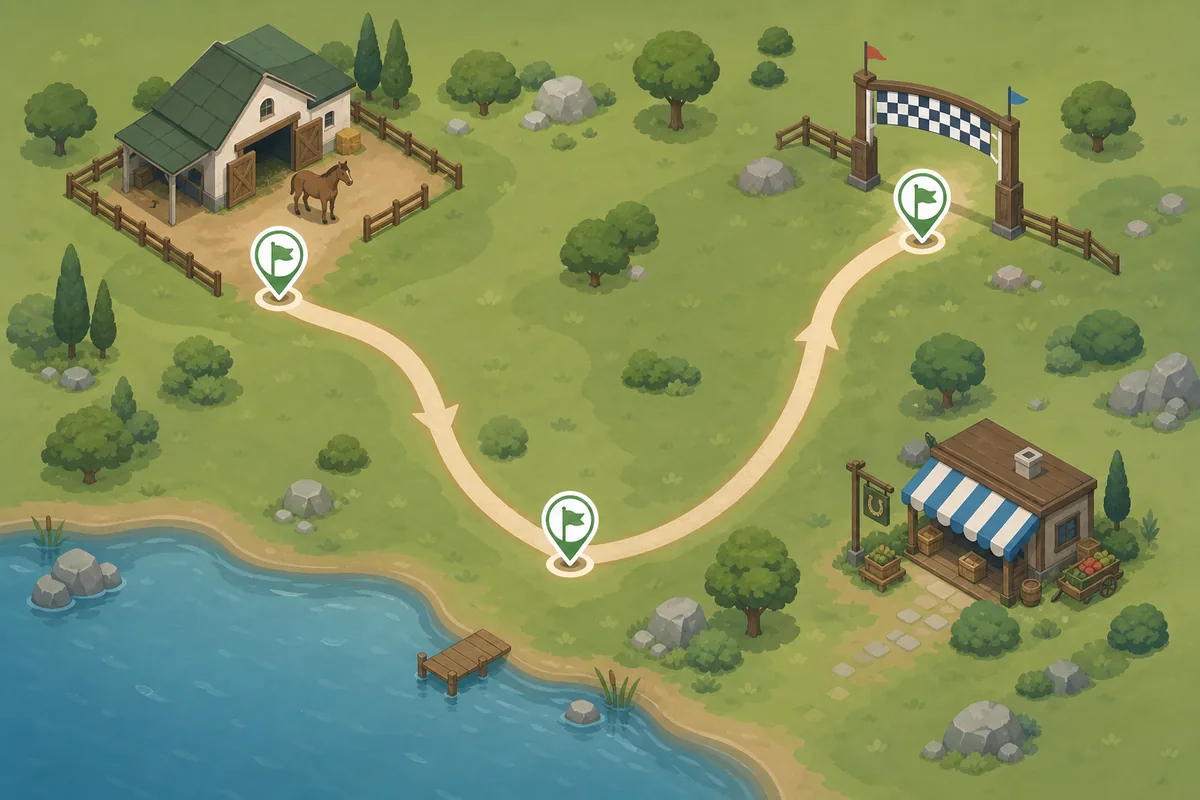
- Explore with purpose: Learn the ranch, track, paddock, trailer, and shops without treating every unknown interaction as urgent.
- Keep a reserve: Save enough for food and the next test before buying a novelty tool or risky horse.
- Name the role: Call the first horse a runner, backup, donor, or experiment so the test has a clear job.
- Write one question: Use the next question to choose a deeper guide instead of mixing every system at once.
Cash and capture
Protect starter cash and choose a useful first horse
In this Horsey Game beginner guide, early cash is a learning budget. Spend it on actions that reveal how the game works, not on a full stable of untested projects. Keep a visible reserve after every purchase. When a race, capture, or interaction goes wrong, the reserve lets you try again while preserving the baseline horse and the notes that explain what happened.
A first horse does not need to be the fastest horse. Look for a body you can control and observe. Can it stay upright when you change direction? Does it recover after a mistake? Can you tell whether a bad result came from fatigue, balance, route choice, or the horse itself? These observations become more valuable than a single high-looking stat.
If you capture a second horse, give it a different purpose instead of making two identical experiments. Keep one stable baseline and use the other for a small comparison. This separation prevents a beginner mistake: changing every horse at once and then having no reference when the stable becomes harder to manage.
- Reserve first: Do not let a single purchase remove the next race, food, or recovery option.
- Prefer control: A readable, stable body teaches more than an extreme shape with unpredictable movement.
- Keep a baseline: Protect one unchanged horse so later breeding or DNA tests have a comparison point.
Horse state
Learn rest, food, fatigue, and balance before breeding
Horsey Game systems overlap, so a tired or poorly prepared horse can make a simple test look like a genetics problem. Before you call a build weak, check whether the horse has rested, whether the needed food is available, and whether the body is already showing a state that changes movement. These checks are part of the Horsey Game tips for new players that save the most wasted experiments.
Watch the whole action, not only the opening burst. A horse may start quickly and then lose control, run out of stamina, or fail to recover after contact. When you write a note, record the first visible failure and the point at which it happened. That gives you a useful hand-off to the racing guide later, where the same pattern can be tested across several comparable runs.
Do not breed simply because breeding is available. Natural breeding is most useful when you have a clear goal and a baseline. If you are still learning which traits affect your route, observe another run first. Once you know the problem, the breeding guide can help you choose parents; if you know the exact change, the DNA guide can help you plan a focused edit.
- Check the state: Rest, food, fatigue, and balance can change a result before genetics become relevant.
- Record the first failure: Use a short note about when control, stamina, or route handling broke down.
- Delay the branch: Wait for a clear question before opening breeding or CRISPR systems.
First race
Prepare and test the first race without chasing a record
Choose an event you can afford and a horse you can describe. The first race is a controlled lesson about entry cost, movement, stamina, turning, and recovery. It is not proof that a horse is good or bad. Keep the event and the general conditions consistent so the result answers one question instead of mixing a new route with a new horse and a new DNA edit.
Run the same comparison more than once before changing the build. One run can be noisy because physics, fatigue, or contact changes the outcome. On each attempt, note the finish, the first failure, and whether the horse recovered. If the same weakness appears again, you have a reason to test one small change. If the results swing widely, investigate preparation or route handling first.
The first race can also tell you which page to read next. A locked button or missing marker belongs on the race troubleshooting page. A repeatable loss belongs on the racing guide. A stable result that earns modestly belongs on the money guide. A promising trait that needs a parent plan belongs on the breeding guide. A known target trait belongs on the DNA codes guide.
Use this three-run pattern as a beginner-friendly version of the deeper racing workflow: baseline, repeat, then one-variable change. Do not copy a community code and call it a universal fastest horse. A shared code is an input to test, and its result depends on the receiving horse, event, and current state.
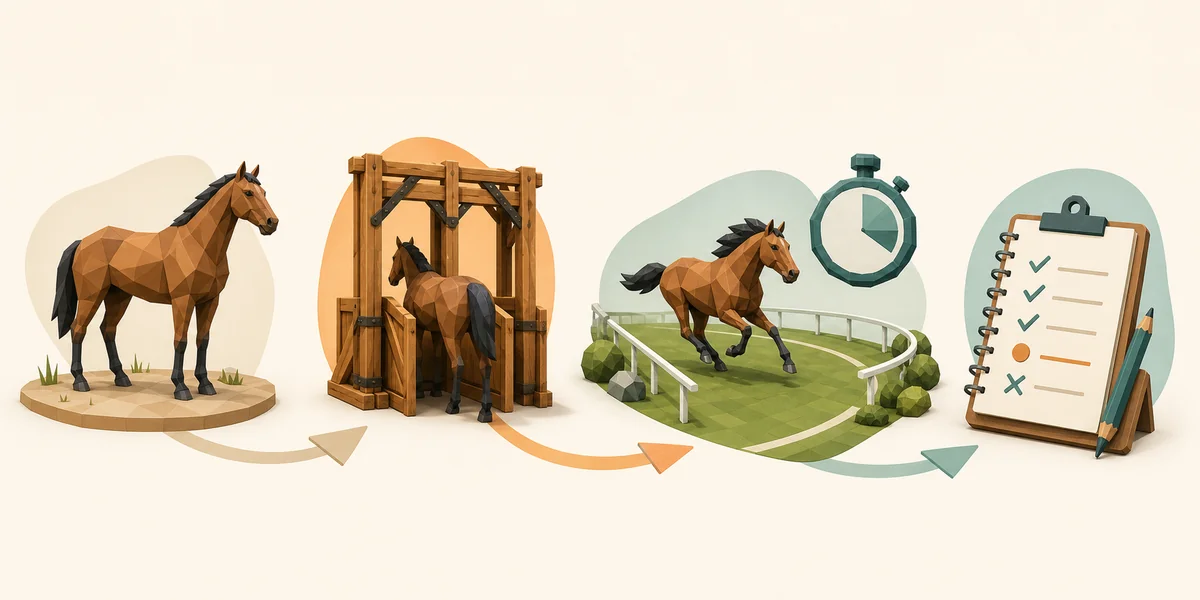
- Afford the test: Keep the entry fee and one failed attempt inside the reserve before you start.
- Hold the route fixed: Use the same event while you learn what the current horse can repeat.
- Run comparable attempts: Record at least a small pattern before you change breeding or DNA.
- Hand off cleanly: Choose troubleshooting, racing, money, breeding, or DNA based on the observed question.
Choose the next guide
Branch into deeper systems only after the opening question is clear
The game becomes easier to understand when each system has a job. Racing asks whether a horse can repeat an event. The money loop asks whether a route pays after fees and failures. Breeding asks which parents can support a named goal. DNA asks whether a focused edit can solve a problem you already observed. The first-hour route should introduce these doors, not force you through all of them.
Use the site map as a decision tree. Choose the racing guide for speed, stamina, balance, and repeat tests; the money-making guide for cash, betting, sales, and fallback work; the breeding guide for parents and foals; the DNA codes guide for helix edits and CRISPR troubleshooting; and the map guide for locations and route planning. This keeps the new-player answer readable while preserving depth for the next search.
- Race question: Use the racing guide when the problem is repeatable performance.
- Cash question: Use the money guide when the problem is net income and reserve planning.
- Trait question: Use breeding or DNA only after you can name the trait and the test.
Recovery
Recover from common beginner mistakes without restarting everything
The recovery section of this Horsey Game beginner guide is deliberately simple: if you spend too much, stop buying and rebuild a small reserve with the safest available task. If a horse loses a race, do not sell it immediately; check rest, route fit, and the first failure. If a build becomes confusing, protect the current state and return to the baseline rather than stacking more edits on top of an unknown change.
A second common mistake is mixing evidence from different systems. A map clue does not prove a DNA code, a community payout does not guarantee the current build, and a screenshot does not prove a universal route. Label community examples as examples, verify live values in your game, and use official Steam information for purchase and platform questions.
Finally, keep the goal modest. The first hour is successful when you understand one horse, one repeatable activity, and the next question. You do not need a perfect racer, a complete genome, or a full stable before moving forward. A clean baseline makes every later experiment easier to explain and undo.
- Stop the spiral: Pause new purchases or edits when you can no longer explain the last change.
- Preserve evidence: Keep the failed state and notes long enough to identify what actually broke.
- Use official boundaries: Use Steam for store facts and avoid unofficial downloads, APK mirrors, or cracks.
Beginner decision table
Which Horsey Game guide should you open next?
Use the first clear question to choose a focused page. This prevents the beginner route from repeating the detailed work that belongs to another guide.
| Your question | First check | Next page | Why |
|---|---|---|---|
| The race is locked or the marker does nothing | Horse state, progression, and access | Race troubleshooting | The problem is access, not build quality. |
| The horse runs but loses repeatedly | Same event, rest, first failure | Racing guide | The problem needs a repeatable performance test. |
| The reserve is shrinking | Entry cost, payout, fallback work | Money making guide | The problem is a net-income loop. |
| I know which trait I want to change | Baseline and one target trait | Breeding or DNA guide | The problem is a planned genetics experiment. |
Repeatable opening
A simple Horsey Game beginner workflow
- 1. Explore Locate the ranch, paddock, track, trailer, food, and shops before committing to a long route.
- 2. Earn Complete one affordable task and keep part of the result as a reserve for the next test.
- 3. Capture Choose one controllable horse, give it a role, and keep a baseline before experimenting.
- 4. Prepare Check rest, food, fatigue, and balance so a state problem is not mistaken for a DNA problem.
- 5. Test Run an affordable event under comparable conditions and record the first clear failure.
- 6. Branch Open the focused racing, money, breeding, DNA, map, or Steam guide that matches your question.
FAQ
Horsey Game beginner guide questions
Sources checked
Beginner route references and boundaries
- Official Horsey Game page on Steam - Use Steam for current purchase, platform, store, and update details; this fan page does not host downloads.
- Getting Started - Horsey Game Guide - Community reference checked for the capture, stats, first race, breeding, and money sequence; values can change.
- Horsey Game Beginner Walkthrough - Community route reference checked for first-day priorities, trailer use, rest, tools, and map boundaries.
- Complete Beginner's Walkthrough - Community cross-check for first-night tasks, race preparation, betting, and the DNA Lab; exact payouts are not treated as permanent.